Can a civilization ban a technology for half a century and call that prudence? It can, and it did. The bill, invisible but punctual, is paid by every passenger who crosses an ocean at the same speed their grandfather did.
There are two ways to govern a risk. The first bans the technology that produces it: it shuts down the entire capability and sleeps soundly. The second regulates the concrete harm and lets engineering find a way around it: it measures, it sets a standard, it rewards whoever meets it. The first produces administrative silence. The second produces progress. And the difference between the two explains why the twenty-first century flies slower than the twentieth.
In 2022, Top Gun: Maverick grossed nearly one and a half billion dollars on an opening scene that is, almost unnoticed, a thesis in regulatory policy. Maverick climbs into an experimental hypersonic aircraft —the “Darkstar,” designed for the film by Lockheed Martin’s own Skunk Works — and, when an officer threatens to cancel the program, takes off anyway and pushes the throttle past the authorized limit. The whole audience thrilled to Mach 10. Few noticed that the real tension of the scene was the oldest one there is: the one who wants to fly faster against the one who defines “safe” as “don’t fly.”
That is exactly what happened in the real sky, without the epic score. In 1973, fed up with the sonic boom that cracked windows and nerves over populated areas, the Federal Aviation Administration issued rule 14 CFR §91.817, which forbids any civil aircraft from flying faster than sound over the United States. The rule did not regulate the noise: it banned the speed. It set no decibel limit for industry to respect: it shut down the whole technology to be safe. And in doing so it froze commercial aviation at the cruising speed of 1958, the speed of the first Boeing 707, where it remains pinned today.
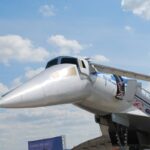
Think of a grandfather who, in the 1990s, connected through Paris to cross the Atlantic aboard the Concorde. The cabin gauge read Mach 2. He had lunch over the ocean at sixty thousand feet, saw the blue curve of the Earth through a window the size of his hand, and landed in New York three and a half hours after takeoff —so fast that, with the time zones, he arrived at an earlier hour than the one he left. His granddaughter, thirty years later, makes the same crossing folded into economy class for eight hours, her neighbor’s elbow in her ribs. The Concorde flew for the last time in 2003 and no one replaced it. It had, to be sure, its own problems of cost and market; but no successor ever took its place — in part because over land the speed remained banned, and the planet’s largest market was closed off in advance— not for lack of engineering, but for an excess of prohibition.
And here is what changed just this spring. On June 5, 2026, NASA’s experimental X-59 broke the sound barrier for the first time over the California desert, at Mach 1.1; days later it flew at mission conditions of Mach 1.4, above fifty thousand feet. The X-59 was not born to break a speed record, but to solve the exact problem that closed the sky in 1973: the noise. Its elongated, almost absurd fuselage spreads the shock wave so that the boom reaching the ground stays under 75 perceived decibels — the muffled thud of a car door down the block— against the more than one hundred that rattled the glass beneath the Concorde. The design is so radical that the aircraft has no forward window at all: the pilot flies looking at a 4K screen fed by external cameras, because a front windscreen would have ruined the very silhouette that silences the boom. The machine that makes supersonic flight quiet already exists. It proved it three weeks ago.
It is not the only proof. Boom Supersonic had already flown its XB-1 demonstrator, which on January 28, 2025 broke the sound barrier over Mojave without a single boom touching the ground, exploiting the physics of “Mach cutoff.” Boom holds 130 firm orders and options from United, American, and Japan Airlines and is building its own engine, Symphony, after Rolls-Royce walked away from the project in 2022. The company even worked out how to fund the airplane without waiting for the airplane: selling gas turbines first, derived from that same engine, to artificial-intelligence data centers. It is a pragmatic detour that says less about supersonics and more about where capital lives today. But the point survives the caveat: the technology exists, it flies, and it attracts investment.
And the 1973 law? Still standing, untouched. On June 6, 2025, an executive order directed the FAA to repeal §91.817 within one hundred eighty days. The hundred eighty days passed months ago and the agency has not published so much as a draft of the new rule. In Congress, the Supersonic Aviation Modernization Act passed the House of Representatives in March 2026 and has slept in a Senate committee ever since. Meanwhile, the only rule in force on the matter remains the one that takes for granted that civil supersonic flight over land is prohibited. The ban that froze the sky for half a century rests on no technical reason anymore: it rests on inertia.
This is what the sky teaches about progress in general. A society that regulates the concrete harm leaves the door open for innovation to solve it and then collect the prize. A society that bans the whole capability out of fear of the harm condemns itself to live with the problem it wanted to avoid and without the solution it could have had. When a rule outlives the reason that justified it, it stops protecting and starts charging. A standard that adapts protects; a ban that ossifies is a museum piece with the force of law. The boom was a real problem in 1973; engineering solved it half a century later; the rule fell asleep in between. And every extra hour we spend over the ocean is a silent tax we pay for a caution that no longer protects anything.
The X-59 has flown. The XB-1 has flown. The machines that would make quiet supersonic flight routine are built, tested, and waiting for a signature. And the only thing missing is not manufactured in Mojave or in Palmdale: it is decided in an office. What is missing is for institutions to move at the speed of the technology they claim to govern. The future rewards societies that correct their rules when reality disproves them, and punishes those that mistake prohibition for prudence and paralysis for care. We closed the sky in 1973, with a signature; no one else can reopen it, also with a signature. The question is no longer whether we know how to make supersonic flight quiet: that was settled on June 5. The question is whether we still know how to repeal a law that stopped making sense years ago. The aircraft is ready. What remains is to find out whether we are.
* José Alberto León Méndez is Project Director at We Are Innovation and Fundación Internacional Bases. With a decade of experience in the nonprofit sector and think tank ecosystems, he specializes in research, international cooperation, and institutional development across Iberoamérica. He is the co-author of four books, including «Después del Socialismo, Libertad» (After Socialism, Freedom). He studied Law at Universidad Central de Venezuela and is currently pursuing studies in Philosophy.
Source: We Are Innovation