How long can a fear outlive the reason that justified it? Too long. Long enough to switch off the cleanest, safest source of energy humanity has ever built, and to christen that blackout “precaution.”
There are two ways to govern a danger. The first measures the real harm, sets a standard, and forces industry to meet it while it produces. The second treats the entire source as a threat, surrounds it with liturgy, and slowly suffocates it. The first disciplines without shutting down. The second shuts down and calls it care. If you treat every atom as a threat, you get coal. If you treat every watt as a good to be produced responsibly, you get progress.
In 2023, Christopher Nolan’s Oppenheimer won seven Academy Awards telling the story of the man who lit the atom and then carried the guilt of having done it. The film left audiences with an image of a tormented, almost penitent Oppenheimer. But the historical Oppenheimer did not want to abolish what he had helped create: he wanted to govern it. The Acheson-Lilienthal Report, of which he was the principal intellectual force in March 1946, proposed an international authority to administer atomic energy, not to bury it. His instinct was institutional: rules, oversight, stewardship of the fire. Civilization did the opposite. It kept the fear and discarded the fire.
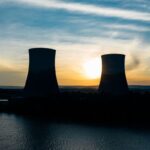
Look at what that fear left behind. On Three Mile Island, in Pennsylvania, there are two reactors. Unit 2 suffered a partial meltdown in 1979, the worst commercial nuclear accident in U.S. history; the average radiation dose to the public was one millirem, against the six of a chest X-ray, and later investigations found no detectable effect on public health. Unit 1, the reactor next door, ran without incident until 2019, when it was closed for losses. The accident killed no one. The panic that followed, by contrast, helped paralyze nuclear construction across the West for half a century, and that paralysis did have victims: the plants that were not built were replaced by burning coal, which kills around 24.6 people per terawatt-hour generated, against 0.03 for nuclear. The nuclear pause did not come free: it was a silent subsidy to the fuel that truly fouls the air and fills the lungs.
The mechanism of that paralysis has a technical name. The Linear No-Threshold model assumes there is no dose of radiation small enough to be harmless, and from it follows the mandate to keep every exposure “as low as reasonably achievable.” It sounds prudent. In practice it turned every safety improvement into a new tightening, every tightening into more cost, and every cost into one fewer plant. The rule did not seek a level of safety and stop when it reached it; it chased an unreachable zero, and in that chase it made building a reactor more expensive than going on burning. Not all of that cost was born in regulation: building few units, losing the supply chain, and financing works that take a decade are expensive in themselves. But the model turned that burden into doctrine, and a doctrine outlasts any single project.
Think of a grandmother in Buenos Aires who switches off the light in every room the moment someone leaves it. She grew up amid scarcities and crises that returned like seasons, and she learned that energy is a luxury to be rationed and a danger to be watched. Today the bill is paid and the grid has plenty, but her finger still reaches for the switch by reflex, because the fear learned to live without the hunger that raised it. The West’s nuclear regulation is that reflex elevated into law: every watt treated as a threat to be minimized, never as a good to be maximized. Fear, when it outlives its cause, stops protecting and starts impoverishing.
And then, just when the story seemed closed, along came those who were hungry for energy and had the money to pay for it. In September 2024, Constellation announced it would reopen Three Mile Island’s Unit 1 and sell all its electricity to Microsoft for twenty years: 835 megawatts, $1.6 billion of investment, a plant renamed the Crane Clean Energy Center that expects to reconnect to the grid in 2027 and has already received a one-billion-dollar federal loan. The monument to fear is going to produce again. And it is not alone. Amazon invested more than $500 million in X-energy and its small modular reactors. Google partnered with Kairos Power to deploy 500 megawatts of advanced reactors by 2035. Meta signed, in January 2026, deals for up to 6.6 gigawatts with Oklo, Vistra, and TerraPower and became the country’s largest corporate buyer of nuclear power.
The initiative did not stay with the tech giants. Oklo began trading on the New York Stock Exchange in May 2024, backed by the SPAC chaired by Sam Altman. Bill Gates’s TerraPower broke ground on its Natrium reactor in Kemmerer, Wyoming, and in March 2026 obtained from the Nuclear Regulatory Commission the first construction permit for a commercial-scale advanced reactor. Congress matched the turn: the ADVANCE Act, designed to speed nuclear licensing, passed the Senate 88 to 2 in 2024. And in May 2025 the White House set, by executive order, the goal of quadrupling American nuclear capacity, from about 100 to 400 gigawatts by 2050. Even fusion, that promise forever thirty years away, showed real signs of life: Lawrence Livermore National Laboratory broke its record with a gain of 4.13 —8.6 megajoules out from 2.08 in— in April 2025, while Commonwealth Fusion Systems signed a deal with Google for 200 megawatts from its first commercial plant, and fusion investment reached $2.64 billion in a single year.
Look at who is rebuilding what the state abandoned. It is not the same state that signed the pause and let it harden for fifty years. It is a different alliance: rules that finally accelerate instead of brake, private capital that needs firm, clean energy for its data centers, and a more honest accounting of risk than the panic of 1979. The market does not replace the state in nuclear energy; it disciplines it, finances it, and gives it a scale no public budget sustains alone. When rules reward building, things get built. When rules punish every watt as if it were a bomb, coal gets burned and the result gets breathed.
This is what the atom teaches about progress in general. Fear is sometimes wise and sometimes a luxury paid for by those who come after. A society that mistakes the absence of risk for safety ends up choosing the invisible risk – the smoke, the bill, the dependence – rather than face the risk it learned to dread. The Oppenheimer of the film carries a private guilt. The Oppenheimer of history left us a public task: to govern the fire instead of putting it out. For half a century we put it out by reflex, and burned in its place what truly made us sick. The generation now reopening Three Mile Island is not inventing anything new; it is rebuilding, with discipline and with rules, what an earlier generation let slip away out of fear. That is what Oppenheimer would not have burned: neither the atom, nor the institutions capable of taming it. The rest – panic dressed as prudence, caution that costs lives – is what the future, rightly, does not forgive.
* José Alberto León Méndez is Project Director at We Are Innovation and Fundación Internacional Bases. With a decade of experience in the nonprofit sector and think tank ecosystems, he specializes in research, international cooperation, and institutional development across Iberoamérica. He is the co-author of four books, including «Después del Socialismo, Libertad» (After Socialism, Freedom). He studied Law at Universidad Central de Venezuela and is currently pursuing studies in Philosophy.
Source: We Are Innovation