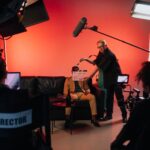
For me, cinema has always been an incredible product of human imagination and a synthesis of someone’s perception of the world. Lighting, framing, color, and at the heart of it all, someone’s story. Filmmaking is a massive team effort. It involves collaboration among many people — professionals and talented minds alike. It entails huge budgets.
With the rise of AI, the film industry could undergo significant transformations, starting with casting and production costs. Regarding special effects and post-production: can technology replace vast teams of technical professionals and lower the budgets required for a film?
On the other hand, could any amateur make a movie? They could simply write a script, purchase a subscription to AI tools, and bring their vision to life. Let’s break it down.
A film is a temporary city. You rent the streets, the lights, the faces, the weeks. You hire people who know how to make rain fall on cue and how to hide the fact that the rain is plumbing. Cast and production absorb the visible money. Visual effects and post-production absorb the invisible money: the months after “cut,” when a world is finished frame by frame. The question AI forces into the open is whether that city still needs so many citizens.
On the industrial side, the answer is already partly yes, but only partly. Technology can replace tasks faster than teams. Rotoscoping, wire removal, sky replacement, crowd multiplication, first-pass previs, dialogue cleanup, some forms of de-aging, lip correction for dubbing: these are the rooms in the building where a model is most at home. They are repetitive, pattern-heavy, and historically under-thanked. If a shot that once required a night of manual painting can be drafted in minutes and merely supervised, the headcount in that room shrinks. A studio does not need a warehouse of specialists for every plate. What remains is a smaller group of people whose gift is to refuse a beautiful mistake.
This is underway. Netflix told shareholders that generative tools appeared on roughly 300 of its titles in 2026, most often after the cameras had gone. McKinsey has estimated that by 2030 the technology could touch about $10 billion of American original-content spending, and that a wider shift might redistribute as much as $60 billion in yearly revenue. On “Dune: Part Two”, machine learning colored the Fremen’s eyes across some thousand shots; Foundry said two-fifths of them needed no hand afterward. Furiosa used a similar blend across about 150 shots. In “Here,” Metaphysic de-aged Tom Hanks and Robin Wright while the camera was still rolling. For Netflix’s Argentine series The Eternaut, co-CEO Ted Sarandos pointed to a collapsing building as the first generative-AI shot to reach the finished picture, and to a pace no ordinary effects pipeline would have allowed. Stephen Follows gathered these production cases.
Money follows that speed. A modest fantasy can show a distant city without dressing itself as a $200 million production. A film can travel into another language without raising a second army. Jeffrey Katzenberg has said that the cost of fine animation may fall by as much as 90% within three years, and that a studio which turns away from the tools risks the fate of Kodak. Aleksandar Todorovic has spoken of live-action costs cut by 95% or even 99%. His caution was the one musicians learned when a record could be made in a bedroom. The record became easy. Being heard did not. The scarce thing moved toward marketing and discovery.
Judgment remains expensive. A likeness carries a legal risk. A set needs insurance. A performance needs continuity. A sequence needs a last decision that makes it feel inevitable. Crews will grow leaner. The dear professional of the coming years may be the one who can see that the thousandth frame is lying.
The people who use these systems already know the weight of them. At TheWrap’s AI Creator Day in September 2026, the actor and director David Bianchi described a clip of three minutes and thirty-eight seconds: 1,200 renders, some $2,500 in computing credits, more than 200 hours from four people.
“I want to dispel the notion that producing AI cinema is easy. It’s f–king hard,” he said. Among more than forty film leaders surveyed that year, a single observation kept returning. The tools ease the making. They make greatness harder, because the audience has seen too much. No serious production begins with just a prompt and boom, suddenly ends with a feature. The ordinary work is duller and more useful: breakdowns, schedules, budgets, call sheets, previs, cleanup, crowds, skies, mouths, skin. The machine took the labor that credit sequences never loved. That is why the quarrel reaches past the star and into the ranks already thinned by streaming, tax credits, and the death of the mid-budget picture.
Studios have been buying the pipes. Netflix paid $587 million for InterPositive, Ben Affleck’s post-production company, so that color, plate cleanup, and the assembly of effects might live inside the finishing of a show. Lionsgate named a chief AI officer, spread the tools through most of its staff, and went further with Runway, including a model trained on its own library. Amazon MGM used a generative fund to order animated series. Google’s reported $75 million in A24 suggests that the look of independence still has a price. None of this guarantees a better film. It changes how many films can be attempted, and leaves the old powers in place: distribution, the franchise, the public’s attention.
Outside the city walls the amateur has always waited. Cameras, actors, rooms, laboratories, distributors, and the leave to spend years on a vision nobody had asked for, making the entry to the industry heavy. A script and a subscription now let a person carry a story into moving pictures without a meeting about the price of a dragon. For the first time in the life of the medium, fantasy doesn’t need to stand in that line.
A run of handsome shots is still not a film. A film is time held in order. A character must live through a cut. A room must remain a room. The rhythm must belong to a mind. Taste, structure, and patience still decide the work, including the patience to discard the first gift the model offers. So the old trade continues in a tighter form. A face that must be loved still wants an actor. A scene that must happen in a real place still wants a company of people. Effects and finishing grow quicker and more closely watched. Sums that were monstrous become merely large. A studio keeps its strength because it can still place a film before the world.
Beside it rises a wide field of private pictures, written at a desk and published into an ocean. Most will pass as most bedroom records passed once music became cheap. A few will arrest us, because their makers could see. The new scarce budget is discovery. Attention takes the place of the crane.
Institutions have begun to write the person back into the rules. For the 99th Oscars the Academy will require a human performance, given with consent, and a screenplay of human authorship. A synthetic player cannot be nominated. A script born of a prompt cannot win. In June 2026, SAG-AFTRA members approved a four-year contract by more than 90 %. Producers accepted a principle that favors human performance. A synthetic figure may replace an actor only when it brings significant added value. A digital replica needs a stated reason to be scanned, consent to be made and consent to be used, pay and residuals. It may not work through a strike. The Writers Guild kept the machine off the credit of writer and forbade any studio from compelling its use. The Directors Guild held that directing is done by a person, and gave the director authority over generated footage. These clauses protect a business that still lives on performances one can own and stars one can sell. A likeness made by software is a poor foundation for that house.
The contracts cover the signatories. They do not cover every channel, every advertisement, every foreign shoot beyond the union, or the tide of short dramas now made by machine. India has used the tools to shrink the cost and the calendar of myth and fantasy; one executive spoke of costs cut to a fifth and schedules to a quarter. Viewers have often received the results coldly, even when they bought a ticket. A cheaper film is not always a loved one. In China, Bona set Sanxingdui: Future Past for the theaters on October 23, 2026, a feature built with AI from end to end, its figures original and digital. More than a hundred people remained on the work. More than 1.2 million source images went into it, and more than a hundred full versions, across two years. The company did not step aside. It learned a new way to spend its time. In the short-drama trade, hundreds of thousands of titles have appeared within months, most of them generated. Cameras cease to be rare. The platform and the hope of being found take their place.
Law has not finished its sentence. American copyright still asks for a human author. When the Supreme Court declined, in 2026, to reopen Thaler v. Perlmutter, a work made by software alone stayed outside protection. A hybrid film may claim the human share: the choosing, the arranging, the directing, the performance. The raw output of a model is thin property. Disney and Universal have sued Midjourney over the use of their libraries in training. Warner Bros. followed. Midjourney has asked the court to make the studios describe their own use of the same class of tools. The quarrel is now a matter of record. The useful questions are older than the software. Who authored the work? Was a face taken with consent? Can the finished picture be owned, insured, and sold?
Viewers have their own measure. Research by NRG and TheWrap found that 64 % of American audiences reject an artificial lead, and 58 % reject a script written from scratch by a model. Only 26 % object to the tools in special effects. Seventy-two % want to be told whenever they are used. In late September 2026, searches for films made without AI rose sharply. After the brief fame of Tilly Norwood, a generated performer and no member of the union, “no AI” began to appear as a mark on a poster and a line in the credits. The inexpensive image is becoming a costly claim to prestige. Craft returns as a selling point, as film stock once did, and the stunt performed in the world.
Work will shift before it ends, and some of it will end. One study placed about 21 % of American jobs in film, television, and animation, some 118,000 roles, among those whose tasks are exposed to consolidation or loss. Exposure is not a count of the fallen. Hours move into prompting, watching, clearance, and the long labor of consistency. Hours leave the first pass of a rotoscope, a transcript, a temporary visualization, a background crowd. New names appear on a call sheet. Mid-skill finishing grows quieter. Vendors already worn by bidding feel the change first. A writers’ room under contract is safer on paper than a compositor hired by the week in another country. Sound ended the pit orchestra and gave us the modern score. Computer images closed some workshops and opened others. The machine will erase duties, invent new ones, and favor the person who still knows what a scene is for.
The spectacle of the demo has done its work. In many cases a model can already lay a finished-looking shot upon a timeline. The remaining difficulties are older and higher: a character who lasts, a joke that lands, the ethics of a face, a clean chain of title, an audience that cares.
Several paths may run together. Effects grow cheaper while serious films still put people in rooms, and the credits grow long with lawyers. More pictures appear, as more songs appeared after the home studio, and most of them vanish, while the old companies live on as merchants of attention and of names. A public may form that pays a premium for work declared human, eligible for prizes, made under a union roof, while another public moves through a cheap and endless stream of shorts, recuts, and advertisements. Each will use the word cinema.
The art has taken in recorded sound, color, television, the cassette, computer images, and the stream. Each time it changed its idea of a film and of the person allowed to make one. This invention reaches further. It asks whether a performance must ever have stood before a camera. Neither development can invent the thing a film requires at the start: a person who needed this light, this frame, this color, this story. Tools can multiply what perception has already left behind, but they can barely supply the need itself.
Audiences will settle the rest in the dark, by an old test. They will ask whether anyone on the screen seems to mean it, AI or human — spectators will decide who’ll run the show.
* Tetiana Rak is the Chief Operations Officer (COO) at We Are Innovation. A journalist and freedom activist with 8 years of experience, Tania has worked with renowned media outlets including CNN, TechCrunch, Fox News, HackerNoon, the BBC, and Radio Free Europe, among others. Her unwavering dedication to championing the ideas of technological advancements and global digital transformations has earned her a distinguished reputation in the field. Through her work, Tania promotes the ideas of liberty and individual rights as a cornerstone of any rights-respecting society. Strengthened by the experience of war in Ukraine, Tania’s beliefs also stand for promoting technological advancements as a transformative tool to advance liberty, giving people the opportunity to speak, act, and pursue happiness without unnecessary external restrictions.
Source: We Are Innovation