The world’s coastlines are wasting away. Megacities from North America to Southeast Asia are struggling with dense populations, aging infrastructure, and ecological collapse. Entire island nations are fighting against submersion due to rising sea levels. Low-lying coastal regions all over the globe are facing the same threat. The more vulnerable our coasts are becoming, a question arises: can we win against the ocean?
As governments search for ways to adapt to a rapidly changing planet, floating infrastructure and floating cities are emerging as some of the most ambitious and promising solutions. Designed to float using buoyant platforms, these solutions offer resilient, expandable, and sustainable urban spaces capable of coexisting with the oceans and seas rather than retreating from them. This article aims to shed light on existing and planned projects involving floating infrastructure, which can serve as a blueprint for the next frontier of architecture and human living.
Many forms of floating infrastructure are already operating around the world today. Together, they demonstrate how floating developments could help societies respond to land scarcity, and rising sea levels in the decades ahead. A few notable examples are:
- Floating Farm Rotterdam: The Netherlands constitutes an historical example on how to curb rising sea levels. Its advanced dike system, which has been preventing floods for centuries, is well-known everywhere. Now, the city of Rotterdam has taken a step forward with its Floating Farm. Inspired by the occurrence of hurricane Sandy in 2012, which left New York out of fresh food and dependent on food trucks, this project intends to improve the resiliency of cities globally. With facilities that are highly adaptable to a changing climate, the Floating Farm provides a stable supply source, empowers local producers and is less prone to disruptions.
- Floating Office Rotterdam: Also located in Rotterdam, the Floating Office positions itself as “a vessel for change”. This modular timber building is climate-resistant, energy positive, CO2 negative and if sea levels rise, it will float. Currently, it hosts three offices, including the one of the Powerhouse Company.
- Jellyfish Barge: The Jellyfish Barge is a modular floating greenhouse that uses solar power to generate fresh water and energy. As a self-sufficient and nomadic facility, it enables food production near consumers without impacting existing resources.
- Hardangerfjord’s Salmon Eye Pavilion: The Salmon Eye Pavilion is a floating exhibition centre located in Hardangerfjorden, Norway. It aims to showcase the possibilities and challenges of the aquaculture industry through an immersive experience encompassing both learning and communion with nature.
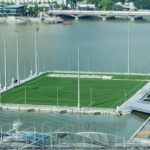
- Singapore’s The Float: Singapore’s Marina Bay is one of the country’s most iconic landmarks. Besides the architectural masterpiece that is the Marina Bay Sands Resort, the area opened, in 2007, a floating stadium – “The Float”. It was the venue for the annual National Day Parade since its opening in 2007, for the Opening and Closing Ceremonies of the Singapore Youth Olympic Games 2010 and the for New Year’s Eve celebrations. Unfortunately, The Float was demolished in 2023, but a 30,000-seat multi-purpose venue is being built in its place.
Some companies, though, are taking the concept of floating infrastructure even further and making plans for entire floating cities. As of May 2026, there is not a fully operational floating city yet, but some exist in prototypes and others are even in the making. A few highlights are:
- Dogen City: Idealized by the Japanese startup N-Ark, Dogen City’s premise is to become “a smart healthcare city on the ocean”. It is projected to be circle-shaped, with a circumference of 4km, and host around 10,000 inhabitants. Some of its most ambitious proposals include becoming a major medical tourism and HealthTech hub, having an evacuation site function to be used as a natural disaster solution and being a safe haven for climate refugees. The city is expected to be completed by 2030.
- Dubai Reefs: Dubai Reefs claims to be “the world’s largest ocean restoration project”. Dubai is already known for its artificial islands on reclaimed land, now it is working on a living lab for marine research, regeneration and ecotourism. Blending leisure with environmental protection, Dubai Reefs aims to generate over 30,000 jobs in a green economy. Its conclusion is set for 2027.
- Maldives Floating City: Maldives is one of the countries of this world that is currently most threatened by rising sea levels, risking submersion day after day. Nevertheless, such an issue opened an opportunity for innovation. This nation of small islands is currently building a Floating City with thousands of colorful houses and a nature-based structure of roads and canals as the main infrastructure for logistics and gateways. Like Dubai Reefs, its opening is set for 2027.
- Oceanix Busan: Located off the coast of Busan, in South Korea, Oceanix Busan is designed to house approximately 12,000 residents and visitors. It encompasses three platforms – one for lodging, one for research and one for living – and it is based on the principles of net-zero energy, fresh water autonomy, zero waste systems, habitat regeneration, plant-based food and shared mobility.
- Oxagon: Integrated in the broader NEOM project, which corresponds to a region in the making in northwest Saudi Arabia, Oxagon wants to integrate industry 4.0 with a circular economy. It is planned to have a 100% renewables-based energy system, an area of 48 km² and a TEU port capacity of 1.5M.
In sum, floating communities and even cities are no longer confined to science fiction or utopian imagination. Across the world, startups, architects, and engineers are already testing how humanity can adapt to an era defined by climate uncertainty, population growth, and environmental pressure. From floating farms and greenhouses to entire maritime urban developments, these projects demonstrate that living on water is becoming a realistic extension of human civilization, rather than a distant fantasy.
As rising seas threaten coasts and entire archipelagos, floating infrastructure offers more than protection: it offers possibility. These projects could redefine urban planning, renewable energy systems, food production, and transportation. In fact, floating cities may represent one of the boldest architectural and societal experiments of the 21st century. In a world where land is becoming increasingly fragile and contested, the oceans may no longer symbolize the limits of civilization, but rather its next horizon.
* Beatriz Santos is the Chief Communications Officer (CCO) at We Are Innovation. She is based in Lisbon, Portugal. Beatriz started publishing articles through her University newspaper and eventually moved to national and international reach outlets, including the well known Portuguese outlets NOVO and Observador. Her professional career includes international communications experience with the ATREVIA agency and the European Parliament. She also has two published books and is an essential part of the Students For Liberty organization in Portugal. With a focus on positive change and global cooperation, Beatriz actively seeks partnerships across the globe to promote innovative initiatives.
Source: We Are Innovation