The delivery industry has undergone a radical transformation over the past two decades. During the beginning of this century, if you wanted to get something directly delivered at your house, you had to rely on phone calls or in-person orders. Now, all you have to do in most places is download an app that, within minutes, will present you countless options, compare prices, track your order in real time, and have almost anything – from food to groceries to electronics – delivered straight to your doorstep.
Everything started with enterprises like Seamless or GrubHub, which digitalized the ordering process. However, the true revolution happened with the digitalization of delivery logistics, brought by platforms such as UberEats, Glovo or DoorDash. Today, almost every major city in the world is served by at least one platform of this type, having a wide fleet of couriers ready to deliver anything anywhere.
Delivery apps are now mostly democratized. Nevertheless, the new frontier is already here: automation.
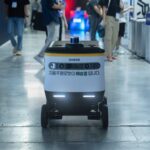
The delivery industry is increasingly partnering up with robotics firms, such as Starship Technologies, Serve Robotics and Avride, to deploy autonomous delivery robots, particularly in dense urban areas and college campuses. Over 60 college campuses across the USA are currently served by delivery robots, as well as a handful of cities in America and Europe.
But there is more. Some companies are pushing autonomous delivery even further by challenging the norms and handling orders not through earth, but through air. With drones, orders are no longer bound to the ground.
The drone delivery industry is still emerging and there are not many players in the game yet. Some companies are only covering North America at the moment. For instance, Flytrex, focused only on the state of Texas, Wing and Amazon Prime Air, operating across the USA, and Drone Delivery Canada, operating across Canada. However, others saw in LMICs (Low and Middle Income Countries) the perfect fertile soil to get goods delivered by air.
Since launching in Rwanda in 2016, the company Zipline has built what is now the largest autonomous delivery network in the world, using drones to transport not just food or retail goods, but also medical supplies like blood, vaccines, and essential medicines.
As of 2026, Zipline is operating in five African countries: Rwanda, Ghana, Nigeria, Kenya and Côte D’Ivoire. Indeed, the continent’s unique structural and technological challenges end up paving the way for innovative solutions. Many parts of Africa struggle with poor road networks, difficult terrain, and long distances between urban centers and rural areas, which make traditional delivery slow and unpredictable. Zipline found a way to overcome all these troubles, becoming a global leader in next-generation logistics.
Besides Zipline, companies like Matternet and Swoop Aero further illustrate how the infrastructural gaps from developing countries are enabling entirely new logistics systems. Matternet has worked with organizations like UNICEF and the WHO to test drone corridors in places such as Bhutan, Malawi and Papua New Guinea, transporting medical samples and demonstrating how aerial routes can complement limited ground infrastructure. Meanwhile, Swoop Aero has deployed large-scale drone networks across countries including Malawi, Mozambique, and the Democratic Republic of Congo, delivering vaccines, lab samples, and essential medicines to remote communities, particularly during crises like COVID-19.
In sum, drone delivery is proving to be not just a question of logistics, but one of human rights and public health. And its advantages should be considered beyond the infrastructural limitations of LMICs. Even for developed countries, delivery through air can act as a crucial resource during emergency situations like floods, fires, earthquakes or blizzards.
From phone calls to algorithms, and now from human couriers to autonomous machines, the delivery industry is undergoing a transformation that extends far beyond convenience. What began as a race for speed and efficiency is evolving into a broader rethinking of how goods and essential services reach people. Ultimately, the future of delivery will not just be defined by technology, but by its ability to make access faster, fairer, and more resilient across the world.
* Beatriz Santos is the Chief Communications Officer (CCO) at We Are Innovation. She is based in Lisbon, Portugal. Beatriz started publishing articles through her University newspaper and eventually moved to national and international reach outlets, including the well known Portuguese outlets NOVO and Observador. Her professional career includes international communications experience with the ATREVIA agency and the European Parliament. She also has two published books and is an essential part of the Students For Liberty organization in Portugal. With a focus on positive change and global cooperation, Beatriz actively seeks partnerships across the globe to promote innovative initiatives.
Source: We Are Innovation